
Purpose
Osteoporosis significantly increases fracture risk, with hip fractures associated with a 20–30% one-year mortality rate.
Although bone mineral density (BMD) measured via dual-energy X-ray absorptiometry (DXA) is the clinical standard, it
does not fully account for fracture risk. Because bone strength is also determined by structural quality, integrating
microarchitectural measures may improve fracture prediction. The Trabecular Bone Score (TBS) is a DXA-derived
textural index used as a proxy for bone microarchitecture. While spine TBS has been used clinically for over a decade
[1], its application at the hip is less established. This study evaluated the correlations between femoral neck (FN) TBS
and microarchitectural parameters derived from high-resolution micro-CT.
Method
Specimen Preparation and Imaging
Thirty dry human cadaveric hips with intact proximal femurs were obtained from the University of Bristol. High-resolution
three-dimensional (3D) reconstructions were acquired via micro-computed tomography (micro-CT) at an isotropic voxel
size of 42 μm. Within the femoral neck (FN), a standardized trabecular region of interest (ROI) was segmented for
morphometric analysis (Fig. 1).
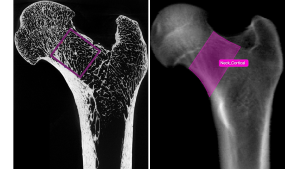
Fig 1: Comparison of ROI definitions. Left: Coronal micro-CT view with the defined volume of interest (VOI) in the neck. Right:
DXA scan showing the application of the neck mask.
Microarchitectural Analysis
The following 3D structural parameters were quantified using Micro-View software (v.2.5.0, GE Healthcare): bone volume
fraction (BV/TV, %), connectivity density (Conn.D, mm^-3), trabecular thickness (Tb.Th, mm), trabecular separation
(Tb.Sp, mm), and trabecular number (Tb.N, mm^-1).
DXA and Textural Assessment
Each specimen was subsequently imaged using a Lunar iDXA system (GE Healthcare). The Trabecular Bone Score
(TBS) was derived from the raw sensor data using a custom-defined femoral neck mask, manually positioned to
correspond with the micro-CT ROI (Fig. 1).
Statistical Analysis
The associations between TBS and 3D micro-CT morphometric parameters were evaluated using Spearman’s rank
correlation coefficients (r).
Result
Femoral neck (FN) TBS demonstrated robust associations with all micro-CT-derived microarchitectural parameters.
Strong positive correlations were observed between TBS and BV/TV (ρ=0.87, p<0.001) and TbN (ρ=0.86, p<0.001). A
moderate-to-strong positive correlation was also noted between TBS and TbTh (ρ=0.68, p<0.001), and connD (ρ=0.67,
p<0.001). Conversely, TBS exhibited a strong negative correlation with TbSp (ρ=–0.88, p<0.001), indicating that higher
TBS effectively reflect a denser, more interconnected trabecular network (Fig. 2-6).
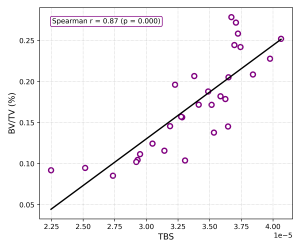
Fig 2: Spearman correlation between femoral neck TBS and BV/TV.
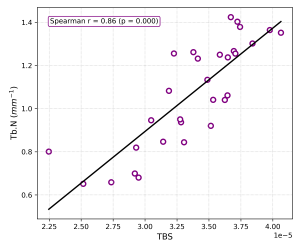
Fig 3: Spearman correlation between femoral neck TBS and Tb.N.
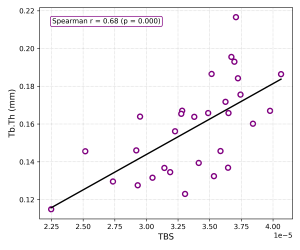
Fig 4: Spearman correlation between femoral neck TBS and Tb.Th.
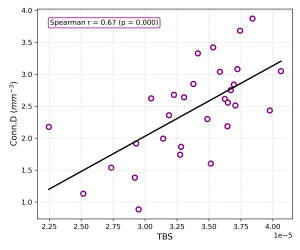
Fig 5: Spearman correlation between femoral neck TBS and Conn.D.
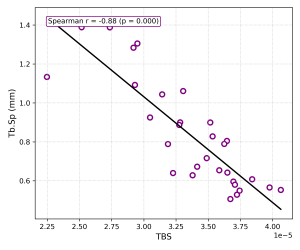
Fig 6: Spearman correlation between femoral neck TBS and Tb.Sp.
Conclusions
This study demonstrates that DXA-based TBS at the femoral neck provides a reliable reflection of the underlying 3D
trabecular microarchitecture. The high correlation coefficients suggest that 2D textural analysis captures the essential
volumetric characteristics of the proximal femur. Translating these findings to in vivo clinical settings is the next
necessary step to determine if hip TBS can improve fracture risk prediction and bone quality assessment across patient
populations.
References
[1] Laurent Pothuaud, Pascal Carceller, Didier Hans. CORRELATIONS BETWEEN GREY-LEVEL VARIATIONS IN 2D PROJECTION IMAGES(TBS) AND 3D MICROARCHITECTURE : APPLICATION IN THE STUDY OF HUMAN TRADECULAR BONE MICROARCHITECTURE. BONE (2008), 42, p775-787.
Related Resources from Medimaps
Learn how Trabecular Bone Score (TBS) enhances bone health evaluation and supports clinical decision-making in osteoporosis management.