
Opportunistic bone health assessment from routine X-ray
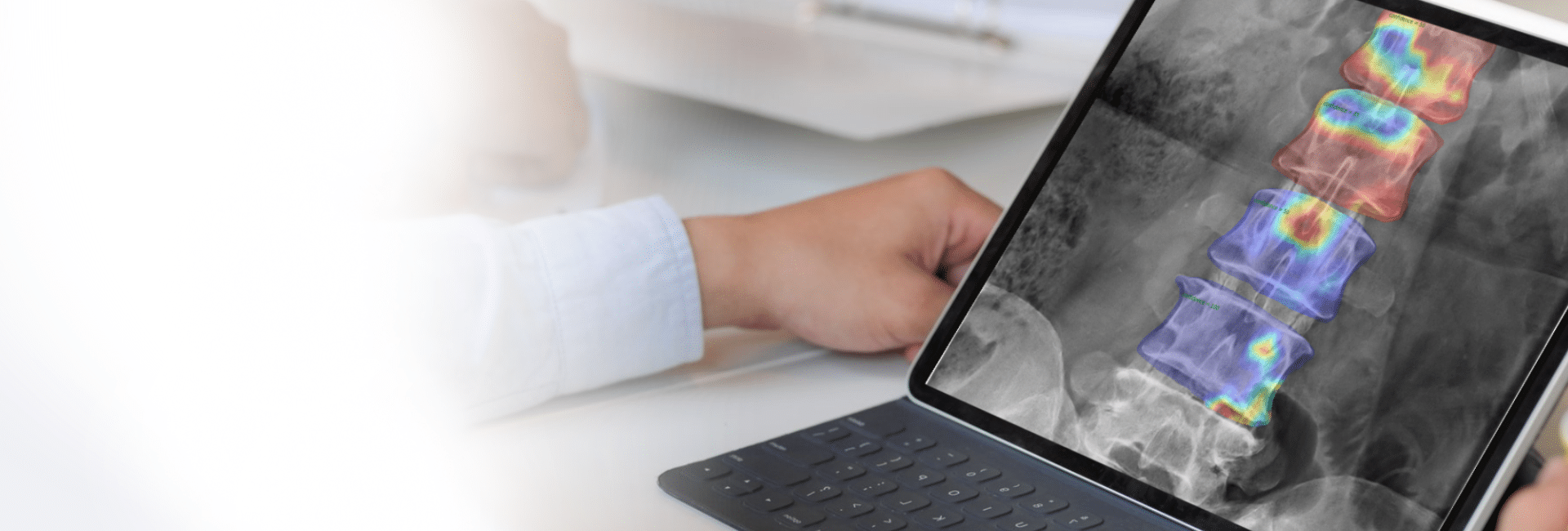
TBS Reveal* is an AI software technology designed to analyse routine X-ray images and generate bone health information that may support earlier identification of patients who could benefit from further assessment.
*The product is under development. TBS Reveal is not yet submitted for regulatory clearance in all markets and is not available for clinical use or sale.
Why this matters
Osteoporosis and poor bone quality often remain undetected until a fracture occurs. Osteoporosis affects millions, often going undiagnosed until a fracture occurs. More than 70% of patients with fragility fractures are never tested or treated for osteoporosis1. Many patients undergo routine X-ray imaging for other clinical reasons, creating an opportunity to utilise these existing images for bone fragility assessment.
TBS Reveal is being developed to help clinicians identify patients who may warrant further bone health evaluation, using standard X-ray imaging and trained using DXA-derived trabecular bone score and osteoporosis classification as the clinical ground truth.
Technology under evaluation
TBS Reveal is designed to analyse routine X-rays and generate outputs related to bone microarchitecture and bone mass. The technology is intended to support opportunistic case finding and to complement, not replace, established clinical assessment pathways.
Its development is focused on integration within routine imaging workflows and on generation of structured outputs for clinical review. Performance and workflow characteristics remain under evaluation.
Objectives of TBS Reveal

To assess bone microarchitecture from conventional X-rays

To detect osteoporosis from conventional X-rays

To provide help in diagnosis

To enable earlier initiation of preventative or treatment strategies to help maintain bone health and prevent future fractures
Status of development
Medimaps has made significant progress in the clinical validation of TBS Reveal software with international, multi-center cohort studies. Preliminary findings from early-stage clinical and technical evaluations have been presented at major scientific and clinical conferences2,3.
1.Compstson 2020; Bluic et al.; 2021
2. Gatineau G, Nguyen G, De Gruttola M, Hind K, Kužma M, Payer J, Guglielmi G, Fahrleitner-Pammer A, Hans D. External validation of AI-driven bone fragility detection in radiographs from multinational cohorts. ISCD 2024.
3. Gatineau G, Nguyen G, De Gruttola M, Hind K, Kužma M, Payer J, Guglielmi G, Fahrleitner-Pammer A, Hans D. Automatic Detection of Bone Fragility in Radiographic Images using Deep Learning with Multi-center Cohort Datasets. Oral presentation, ECR 2024